
Among the many benefits of green tea that we'll be discussing this year, we want to start with how it impacts one of the biggest growing challenges we face today: mental health. Some conditions are genetic, some are caused by external factors, and sometimes we simply need a little help with our memory or mood. Regardless, there are fundamental steps we can take to address these challenges and even improve them over time. To begin, how can consuming green tea help combat and protect us from mental health issues?
Short on time? Scroll down for 5 quick learning points.
Fighting dementia
As we age, our ability to think, remember, and reason can decline. However, simple age-related forgetfulness and the development of dementia (e.g., Alzheimer's, Parkinson's, etc.) are different. Small blood vessels in the brain become damaged over time. When abnormal proteins accumulate in certain parts of the brain, they damage healthy brain cells and cause them to die. In healthy individuals, the brain's immune system removes these abnormal protein plaques by responding to the inflammation they cause. However, if this response is inadequate and the inflammation persists for an extended period, brain cells are damaged, and dementia develops.
Catechins are natural antioxidants found in fruits, vegetables, and even wine and chocolate, but are most abundant in green tea. The most important catechin in green tea is called EGCG (epigallocatechin gallate). In one study, brain cells from the hippocampus (the part of the brain that regulates memory) were exposed to beta-amyloid proteins (Alzheimer's plaques). The higher the exposure, the more brain cells died. However, when the green tea catechin EGCG was added, the survival rate of the brain cells increased. This demonstrated the powerful antioxidant effects of EGCG on the brain.
Because the brain is such a vital organ in our body, it has a natural barrier that carefully controls what passes from the blood into the brain (like a doorman guarding the door to a VIP room). EGCG crosses this blood-brain barrier very easily (like a VIP). This allows it to act directly on the brain, potentially improving blood vessel health and increasing nitric oxide production, which together could enhance cognitive function.
In some Eastern countries where tea drinking is part of the culture, studies have been conducted on the difference between people who drank green tea over time and those who didn't. The results showed that people who drank more green tea over a longer period had a lower risk of cognitive impairment. In other words, it's important to drink green tea regularly now to be protected against mental illness later in life. *Remember, prevention is key to dementia.
Think of theanine
Another very important component of green tea is an amino acid called theanine. It is found only in some mushrooms and teas, but especially in green tea. Theanine has strong neuroprotective effects on brain cells. Like EGCG, theanine is another VIP for the brain, meaning it can easily cross the blood-brain barrier. This direct access may allow it to improve neuroplasticity (the brain's ability to form new connections between neurons). In another study, mice fed theanine twice a week showed increased production of BDNF*, which led to improved memory and learning ability.
*BDNF: Brain-derived neurotrophic factor [plays an important role in the survival and growth of nerve cells].
Theanine also helps lower levels of stress hormones in the blood. When stress hormone levels are high, there is a reduced potential for connections between neurons to improve and change. When stress hormone levels are lowered, it supports our neurons in forming better connections. Essentially, fewer stress hormones equal better brain function. Theanine's effects on reducing stress and anxiety can be seen as yet another way green tea protects brain cells from stress and age-related damage.
The calming effect of caffeine
In our sleep blog, we explained that a substance called adenosine increases in our bodies throughout the day. The more adenosine accumulates, the more tired we become.
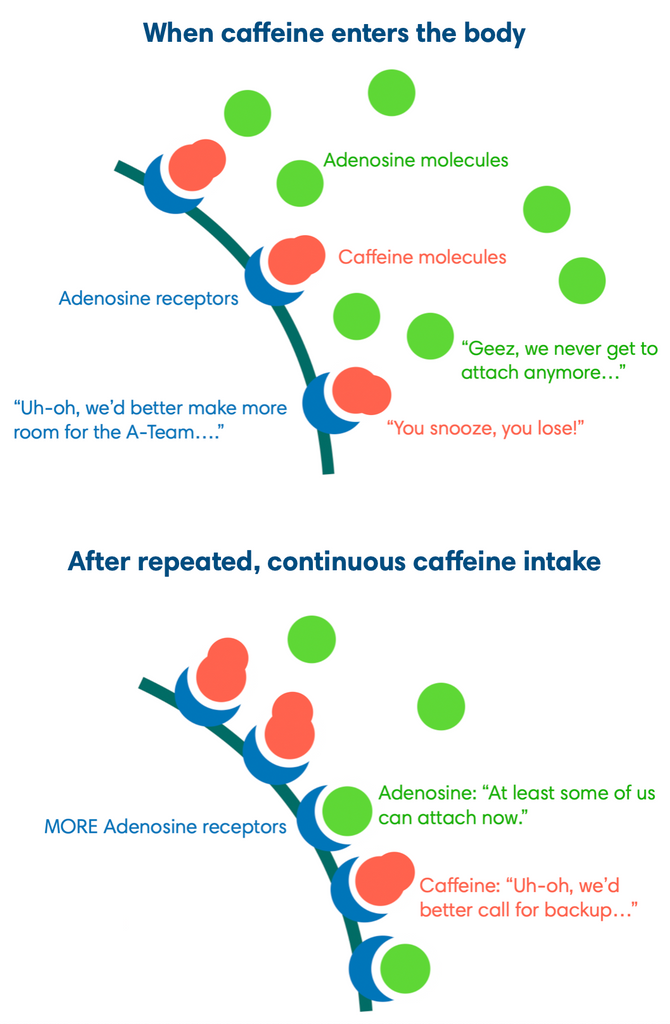
Caffeine alone can cause anxiety by increasing heart rate and adrenaline release. Adrenaline (the "fight-or-flight" hormone) is sometimes necessary, but it has harmful effects when released too frequently over a long period. Green tea, however, naturally contains a unique combination of caffeine, catechins, and theanine. Why is this important?
Theanine's structure is similar to that of GABA (a neurotransmitter that inhibits the excitability of the nervous system) and it has the same calming effects. However, studies show that, unlike other anti-stress herbs, theanine does not cause drowsiness while simultaneously keeping the stimulating effects of caffeine in check. These calming and caffeine-modulating effects may explain why many people experience less anxiety and better sleep after consuming green tea daily. In fact, research shows that theanine reduces anxiety and also helps control high blood pressure.
Now, those who want the energizing effects of caffeine might think that the theanine in green tea makes the caffeine too weak for them. But consider this study: When people took caffeine along with theanine, they had faster reaction times, faster numerical calculation times, improved sentence comprehension, and increased alertness compared to taking caffeine alone.
In another study, one group of people received plain water before meditation, while another group received water with added theanine. After 90 minutes of meditation, the group without theanine reached alpha waves in their brains (relaxed, focused, alert). The group with theanine, however, reached alpha waves after only 45 minutes and with greater intensity. No wonder green tea was regularly consumed by Japanese monks and samurai as early as the 12th century!
It has also been shown that consuming EGCG (the most abundant catechin in green tea) not only increases alpha waves (calm, meditative state) but also theta waves (relaxed, dreamy state) and even beta waves (attentive, focused state) in the brain. In other words, it supports a relaxed and focused state of mind.
When the many components of green tea are extracted and studied separately, raw studies show limited results regarding their benefits. However, all these components are structured in such a way that they exist together in green tea, and many studies suggest a synergistic reaction in which they enhance each other's positive effects on mental and overall health.
In short: Dementia begins with prolonged inflammation in the brain. Green tea is anti-inflammatory. Consistent, long-term consumption of green tea may help protect against future dementia. Remember, there is no cure for dementia, only prevention. EGCG and theanine have VIP access to the brain. They improve brain function and reduce stress and anxiety. The theanine + caffeine in green tea = calm, focused, alert. And no caffeine crash. Before you reach for supplements: There's magic in the natural synergy of green tea's benefits.
There's another very important factor closely linked to mood and mental health: our gut. Next time, we'll cover that and give you some great tips (besides drinking green tea) on how to improve your mood and mind!
References
https://pubmed.ncbi.nlm.nih.gov/30273101/
https://pubmed.ncbi.nlm.nih.gov/31758301/
https://www.nature.com/articles/d41586-019-00398-1#ref-CR7
https://thebrain.mcgill.ca/flash/i/i_03/i_03_m/i_03_m_par/i_03_m_par_cafeine.html
https://www.mdpi.com/2072-6643/10/9/1201
https://pubmed.ncbi.nlm.nih.gov/20617284/
https://pubmed.ncbi.nlm.nih.gov/17013636/
https://pubmed.ncbi.nlm.nih.gov/18006208/
https://pubmed.ncbi.nlm.nih.gov/22127270/
https://pubmed.ncbi.nlm.nih.gov/28899506/
https://www.liebertpub.com/doi/pdf/10.1089/10762800151125092